
Microplate Readers and Their Functions
Amanda2026-08-27T15:45:58+00:00Previously, we’ve gone over the differences between a spectrophotometer and a microplate reader. In today’s article, we’ll dive deeper into what sets different plate readers apart, their functions, and modes. That gives you a basis for choosing the type of machine you need and understanding the advantages of a microplate reader. Now that you are confident that you need a plate reader, the first decision should really be which modes you need to read. The main categories of a microplate reader are absorbance, fluorescence, and luminescence.
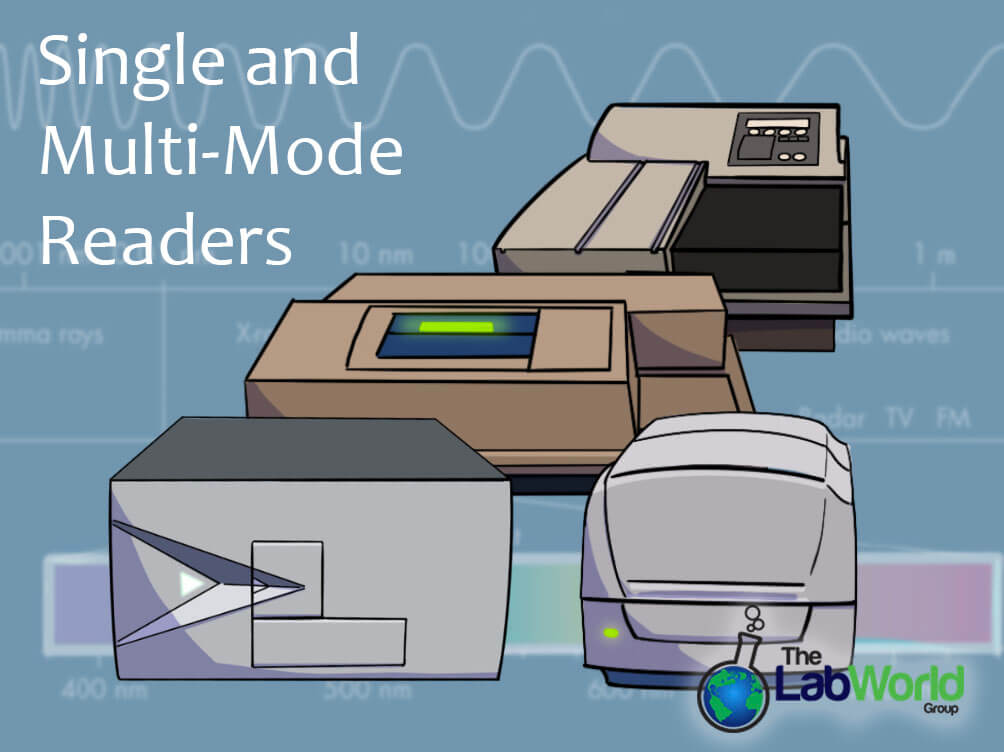
Single-Mode vs. Multimode Plate Readers: What’s the right call?
Aside from project scope, one of the largest determining factors in narrowing the field of choices is cost. A single-mode dedicated instrument is generally less expensive than one with multiple reading capabilities. Having a dedicated plate reader may be all your project needs, offering more precise results while freeing up funds for other critical lab equipment.
Microplate readers from makers like Tecan and Biotek are often modular, so even if you begin with a single-mode reader, chances are you can expand capabilities if your research needs change. That added flexibility can open many possibilities. However, remember that adding a module can often be very expensive, as it requires an on-site visit from the manufacturer. The individual module is often more expensive afterward, and installation adds another cost.
Consider a multimode plate reader if you have multiple users, a larger project, or multiple projects running simultaneously in your lab. Starting with a plate reader with multiple read options helps future-proof projects and keeps research moving uninterrupted. Switching between modes also lets you collect multiple data points and get a more complete picture of the samples you’re working with. Multi-mode Microplate Readers can also save valuable bench space by consolidating everything into a single footprint. By understanding how you and your coworkers will use the instrument day to day, you can determine which type of reader best meets your needs.
Which assays do you need to perform?
The next question is: which assays do you need to perform? This will tell you which modes and sub-modes you may need in your plate reader. The most popular read modes tend to center on three functions: Absorbance, Fluorescence, and Luminescence. Some of these modes can be further subdivided into even more specialized versions.
Absorbance Readers
Absorbance plate readers and UV-Vis readers send light at a specified wavelength through the plate well; this range can span UV to Near-infrared (NIR). Molecules are then measured by how much light they absorb. This detection method is most popular for assays such as Protein Quantification (e.g., ELISA), Cell Viability Assays, and Microbial Growth Assays.
Fluorescence Plate Readers
Fluorescence Intensity signals are collected when a broadband light source is filtered by a selected excitation wavelength that excites the fluorophore or fluorescent chemical compound. In a mere nanosecond, this fluorophore converts the absorbed wavelength into an emission wavelength, releasing kinetic energy and heat. Because intensity is linearly proportional to fluorophore concentration, the detector can quantify fluorescent molecules.
Other specialized fluorescent modes include Fluorescent Polarization, in which polarized light excites the molecule and can be used to detect molecular weight. Smaller, lighter molecules depolarize the emission and move faster, whereas heavier molecules move more slowly and retain polarization. Other techniques include Time-Resolved Fluorescence, where emissions last a millisecond instead of a nanosecond, and TF-FRET, which is closely related to time-resolved but also considers proximity and energy transfer between molecules, as in binding studies.
Luminescence Plate Readers
Luminescence readers collect emitted light that occurs without prior excitation of a molecule. Generally, this results from a chemical reaction, either spontaneous or catalyzed. Since no excitation source is required, a Luminescence reader does not need filters; it only needs a sensitive detector. This mode can provide additional information about a molecule when paired with other modes and can be used in assays such as cell viability, reporter assays, and BRET-based assays.
Other Microplate Reader Considerations
In addition to reading modes, there are a few final components to consider. A detector, typically a photomultiplier tube (PMT), takes signal measurements. As the plate reader runs, it generates light signals and measures and analyzes biological, chemical, or physical changes. PMTs convert those photons into electrical signals for the reader’s software to quantify. PMT capabilities can also include red sensitivity.
Other functions that can aid in cellular and enzyme assays are incubation and shaking. Incubation lets users raise the temperature at key times or at set intervals, enabling temperature-sensitive assays to run in a single location. Shaking functions, usually across a range of speeds, directions, and durations. Shaking helps keep conditions uniform across wells and ensures items are mixed properly after an injection. Users can direct orbit, double orbit, or linear shaking, as well as intensity, to customize to well size and liquid-volume requirements.
Final Thoughts…
If your funding allows you to future-proof your research project, starting with a multimode reader is an ideal choice; as your needs change, the flow can continue.
Sometimes you already know what you’re looking for and the assays and kits you’ll be using throughout, in which case a single-mode, specialized microplate reader is all you need.
In either case, you can stretch your budget even further by opting for a gently used microplate reader from a reputable seller.
The plate readers offered for sale by The Lab World Group undergo rigorous quality checks and refurbishment processes. When they are ready for sale, we provide current verification reports showing all components are up and running to factory specifications. Our inventory changes daily, so if you have a specific assay in mind but don’t see exactly what you need, let us know; we’re here to help!