

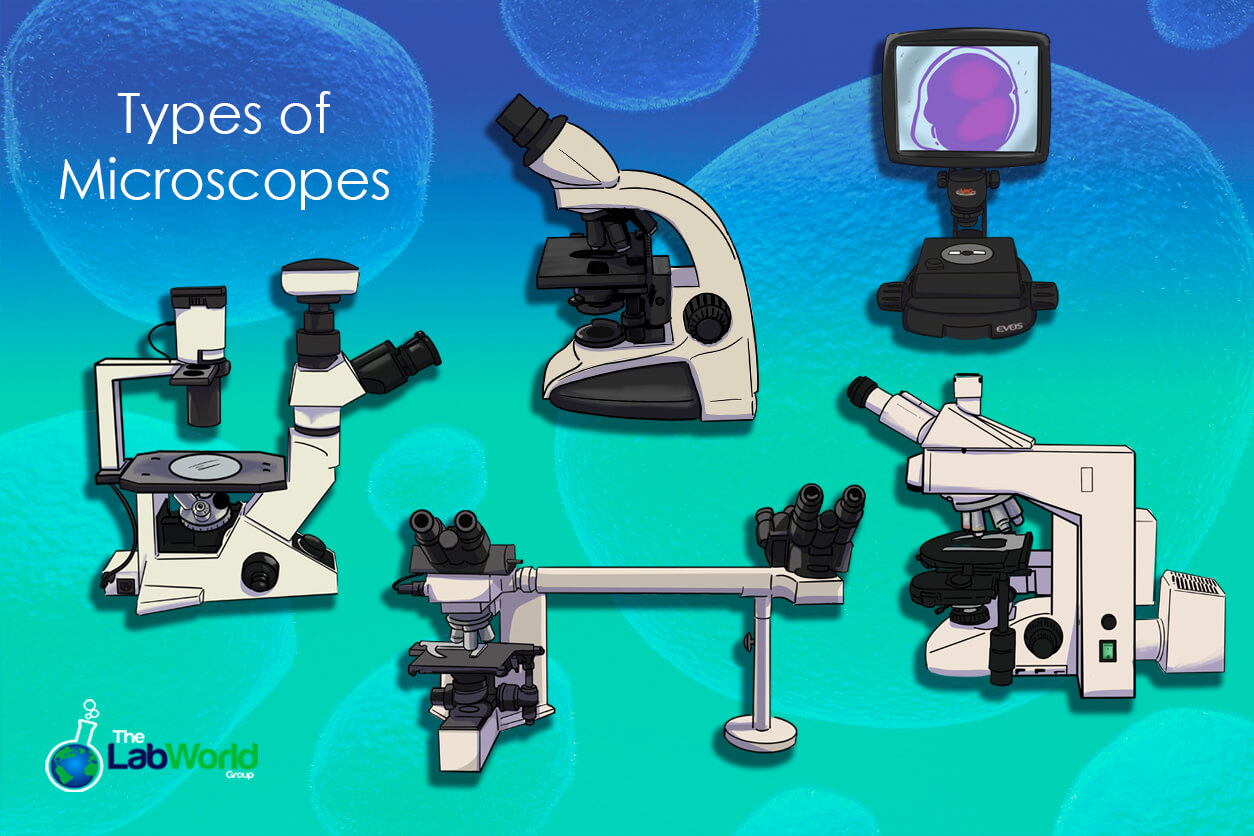
A Guide to Different Types of Microscopes
Amanda2025-09-24T14:46:05+00:00Microscopes are used worldwide in various fields, industries, and research and education settings. Each microscope is designed to meet specific needs and provide unique insights into the world of the microscopic. Understanding the various types of microscopes enables researchers and students to select the most suitable tool for their observations. Here’s an overview of some common types of microscopes, including inverted, compound, stereo, metallurgical, and polarizing microscopes.
Compound Microscopes
Among the most commonly found types of microscopes used in biological research laboratories and educational settings is the compound microscope. These instruments consist of a series of lenses that combine to provide higher magnification, typically from 40x to 1000x. The basic design includes an objective lens system and an ocular lens (eyepiece). Key features include objective lenses of varying magnifications (e.g., 4x, 10x, 40x, 100x), a flat stage for slides, often equipped with mechanical stage controls for precise movement, and a light source positioned beneath the stage. A compound microscope is ideal for viewing thin, transparent specimens such as cells, tissues, and microorganisms.
Inverted Microscopes
Inverted microscopes are designed with the objective lenses below the stage and the illumination system above the specimen. This configuration enables the observation of samples in containers such as Petri dishes or flasks. Key features of these microscopes include a rotating turret of objectives positioned below the stage, which is generally larger than the typical microscope stage to accommodate larger vessels. The illumination is often a ring light or LED. Inverted microscopes are ideal for cell culture studies, microbiology, and materials science, where samples need to be observed in a contained environment.
Stereo Microscopes
Stereo microscopes, also known as dissecting microscopes, offer lower magnification compared to compound microscopes, usually ranging from 10x to 50x. However, what they do offer is a more three-dimensional view of a specimen. Stereo Microscopes have two optical pathways at a slightly different angle, creating a 3D view, and making them ideal for examining larger, opaque objects. Key features of a stereo microscope include a zoom capability that creates continuous magnification adjustments rather than fixed magnification levels, and a greater working distance between the specimen and the objective lens. These microscopes are typically used for dissecting specimens, inspecting circuit boards, or examining large samples such as rocks, insects, and plant structures.
Metallurgical Microscopes
Metallurgical microscopes are specialized for examining the microstructure of metals and alloys. They are designed to handle reflective surfaces and opaque materials, providing detailed images of metal grains, fractures, and coatings. A metallurgical microscope utilizes reflected light illumination that bounces off the surface rather than passing through it, along with high magnification of up to 200-500x, allowing for the detection of micron-level cracks on a surface. These microscopes often use polarizing filters to enhance contrast and reveal stress patterns or phase differences in the sample. These also feature robust construction to withstand rough surfaces such as metals, stone, and ceramics. Essential in materials science, engineering, and quality control for analyzing metal properties, detecting defects, and examining material surfaces.
Polarizing Microscopes
Polarizing microscopes are also equipped with polarizing filters, a polarizer, and an analyzer that create light polarization, allowing users to examine birefringent materials. These materials split light into two distinct rays, and being able to see this provides insight into geology, chemistry, and materials science, as well as the study of minerals, crystals, and other birefringent materials. It is also used in forensic science for examining fibers and other trace evidence. Key features may include compensators to enhance contrast and reveal additional details, as well as a rotating stage that allows the specimen to be rotated to observe changes in optical properties.
In Conclusion
Each type of microscope serves a unique purpose, tailored to specific kinds of observations and materials, from Compound microscopes for biological specimens to stereo microscopes for a three-dimensional view of larger objects. Inverted microscopes facilitate the study of samples in culture dishes, metallurgical microscopes are essential for analyzing metal structures, and polarizing microscopes reveal intricate details of birefringent materials.
Our inventory of Microscopes is constantly changing. We have carried many microscopes through the years and are familiar with their various objectives, techniques, and uses. Understanding the features of each microscope enables you to select the most suitable tool for the job, providing valuable insights into the microscopic world. Let us connect you with the best instrument while also freeing up budget space. Connect with us today to learn more.