What Is the QuantStudio Platform?
Most labs narrow their choice based on three factors: throughput, block flexibility, and whether they need relative (qPCR) or absolute (digital PCR) quantification. QuantStudio instruments are real-time PCR and digital PCR systems built around fast thermal cycling, sensitive optical detection, and scalable software workflows. Depending on the model, QuantStudio systems support routine and multiplex qPCR, gene expression profiling, SNP genotyping and allelic discrimination, high-throughput screening, and digital PCR for absolute quantification. Rather than offering a single, universal platform, the QuantStudio lineup is intentionally segmented to let labs balance simplicity, flexibility, throughput, and analytical precision without paying for capacity they don’t need.
QuantStudio System Tiers (How Labs Typically Choose)
Routine qPCR Systems
Designed for predictable assays and day-to-day workflows where ease of use and fast turnaround matter more than extreme flexibility. These systems are commonly found in teaching labs, small research groups, and QC environments.
Modular & Scalable qPCR Systems
Built for labs that expect assay expansion, shared instrumentation, or changing throughput requirements over time. Modular block configurations allow systems to grow without replacing the entire instrument, making them well-suited for growing research teams and shared lab spaces. This flexibility is where many labs land when upgrading from entry-level systems.
Advanced & High-Throughput qPCR Systems
Optimized for large sample volumes, complex multiplex assays, and continuous operation. These systems emphasize performance ceilings, consistency, and long-run reliability and are typically used in core facilities and clinical or production labs.
Digital PCR (dPCR)
Digital PCR systems partition samples into thousands of reactions, enabling absolute quantification without the need for standard curves. This process improves sensitivity for low-copy targets and rare variant detection and is commonly used for mutation analysis and copy number workflows.
QuantStudio Model Comparison
The comparison below highlights the practical differences labs typically consider when choosing between Thermo Scientific QuantStudio models.
Model | Category | Block Flexibility | Multiplexing / Assay Complexity | Typical User |
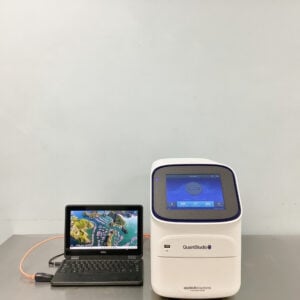
QuantStudio 5 | Routine qPCR | Fixed | Standard multiplex | Small labs, routine testing |
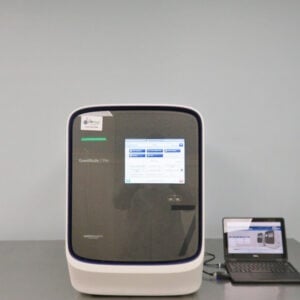
QuantStudio 6 Flex | Modular qPCR | Modular | Moderate to advanced | Growing or shared labs |
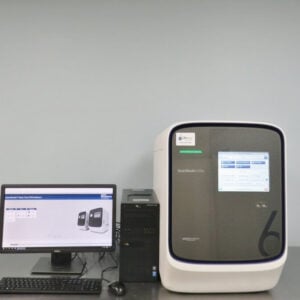
QuantStudio 6 Pro | Advanced qPCR | Fixed | Advanced | Regulated or higher-volume labs |
QuantStudio 7 Flex | Advanced modular qPCR | Highly modular | Advanced multiplex | Core labs, assay development |
QuantStudio 7 Pro | Production qPCR | Fixed | Advanced and validated | Clinical and production labs |
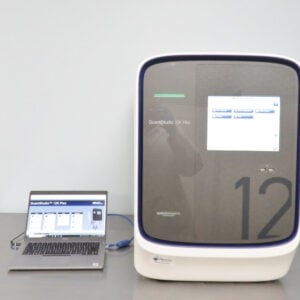
QuantStudio 12K Flex | High-throughput qPCR | Modular | Very high | Core facilities, large studies |
QuantStudio Absolute Q | Digital PCR | Partition-based | Absolute quantification | Precision and rare-target workflows |
Why Labs Buy Pre-Owned QuantStudio Systems in 2026
For many labs, purchasing a pre-owned QuantStudio system is no longer a compromise but a strategic choice. Widely adopted models such as the QuantStudio 7 Flex are now readily available on the secondary market at a fraction of the cost of new systems while still supporting modern assays and current software workflows.
New instruments often involve long lead times and higher capital investment. In contrast, pre-owned systems offer immediate availability, lower acquisition cost, proven platform stability, and verification documentation confirming operational performance before shipment.
For labs prioritizing speed, budget control, and validated performance, pre-owned QuantStudio systems are often the fastest path to deployment.
How to Choose the Right QuantStudio System
Most labs narrow their options quickly by considering sample volume, assay stability, quantification requirements, and whether the system will be shared across teams. Routine workflows benefit from simpler fixed-block systems, while expanding labs often choose modular platforms to avoid early obsolescence. Digital PCR systems are best reserved for applications where sensitivity and precision outweigh cost per sample.
QuantStudio Buying and Verification FAQs
Is QuantStudio Design and Analysis software transferable?
Yes. QuantStudio systems typically use Design and Analysis Software 2.x, which is widely supported and commonly available without restrictive licensing barriers. In most cases, labs can install and use the software without purchasing additional licenses.
How do I know a pre-owned QuantStudio system is performing correctly?
Each system should be functionally verified prior to shipment using standardized performance checks that assess thermal, optical, and amplification performance.
What is an RNase P Verification Report?
RNase P testing confirms proper amplification, thermal uniformity, and optical detection across the block. This report serves as a documented performance record for the instrument.
Are pre-owned QuantStudio systems suitable for regulated workflows?
Many labs deploy pre-owned QuantStudio instruments in regulated environments when appropriate verification documentation, software compatibility, and validation requirements are met.
When should I choose digital PCR over real-time PCR?
Digital PCR is best suited for detecting rare mutations, low-copy targets, and workflows that require absolute rather than relative quantification.



 Select options This product has multiple variants. The options may be chosen on the product page
 Select options This product has multiple variants. The options may be chosen on the product page
 Select options This product has multiple variants. The options may be chosen on the product page
 Select options This product has multiple variants. The options may be chosen on the product page