
A Guide To Microplate Readers
Amanda2026-08-27T15:43:23+00:00Microplate readers have become indispensable tools in today’s laboratories. These compact spectrophotometers expand not only in the number of samples you can measure at once, but many are built to perform multiple methods of measurement. A microplate reader allows users to measure biological, chemical, and physical events and can provide dedicated single- or multi-mode functionality. Some brands offer modular systems that can be expanded as your research grows. In the rest of the article, we will explore the variables that make plate readers so useful in the lab.
Microplate Reader vs Spectrophotometer: What’s the difference?
A microplate reader is essentially a spectrophotometer, but with a few key differences. While a spectrophotometer uses a monochromator or filter-based optics to measure events in samples, just like a microtiter plate reader, it works with a single small sample. Light is sent through the cuvette horizontally, whereas in a microplate well, it passes vertically. The cuvette capacity provides greater precision and is ideal when sample availability is limited. However, that added sensitivity can complicate readings due to artifacts and trace elements.
A microplate reader, on the other hand, uses multiwell plates, usually 96 or 384 wells, sometimes up to 1536! This allows users to test many samples at once and can be particularly useful at the start of research. Multiple samples let users narrow a field of candidates and compare results under uniform conditions. Another consideration is how quickly you want results, how high your throughput should be, and whether your assay needs shaking and incubation steps. You can read more about the differences between a Microplate Reader vs a Spectrophotometer here.
Single-Mode vs. Multimode Plate Readers: What’s the right call?
A wide range of plate readers is available, each with a variety of functions. One of the first questions users should consider is project scope. Will my research expand, or is it focused on one principle? If it’s the latter, then finding an instrument that reads in multiple formats, or is even modular like those offered by Biotek, will come in handy down the line. Multi-mode readers allow for flexibility and save valuable bench space in the lab. However, if your lab’s needs center on a single method, a dedicated microplate spectrophotometer can provide dependable, precise results, saving time and reducing initial costs.
Modes and Assays
Plate readers, as discussed above, can perform multiple reading functions within a single instrument. Absorbance and UV-Vis readers use a specified wavelength to detect and quantify light photons absorbed or transmitted through a liquid sample in the plate wells. This can be achieved using either a monochromator or a filter-based system to get the desired wavelength. Other read modes include specialized Fluorescence Microplate Reader options such as Top and Bottom reading, Fluorescence intensity, Time-Resolved Fluorescence, and Fluorescence Polarization. Plate readers can also feature Luminescent reading, in which the light emitted by a substance is measured, either via a chemical reaction or bioluminescence. This does not involve excitation of the sample but can help clarify other measurements taken by a reader.
Microplate Reader Brands
Plate readers and their many flavors are offered by brands long known for dependable results and quality components.
- Biotek plate readers have had many versions over the years; models are often modular and usually incorporate heating and shaking elements for assay control. They can also include dispensing modules, allowing for the strategic addition of reagents during a run.
- Molecular Devices plate readers offer a wider range, starting with dedicated single-mode Absorbance readers and UV/Vis options and gradually expanding as you move up in models, adding cuvette reads for traditional spectrophotometry, HTRF, AlphaScreen, and Western blot, and even imaging.
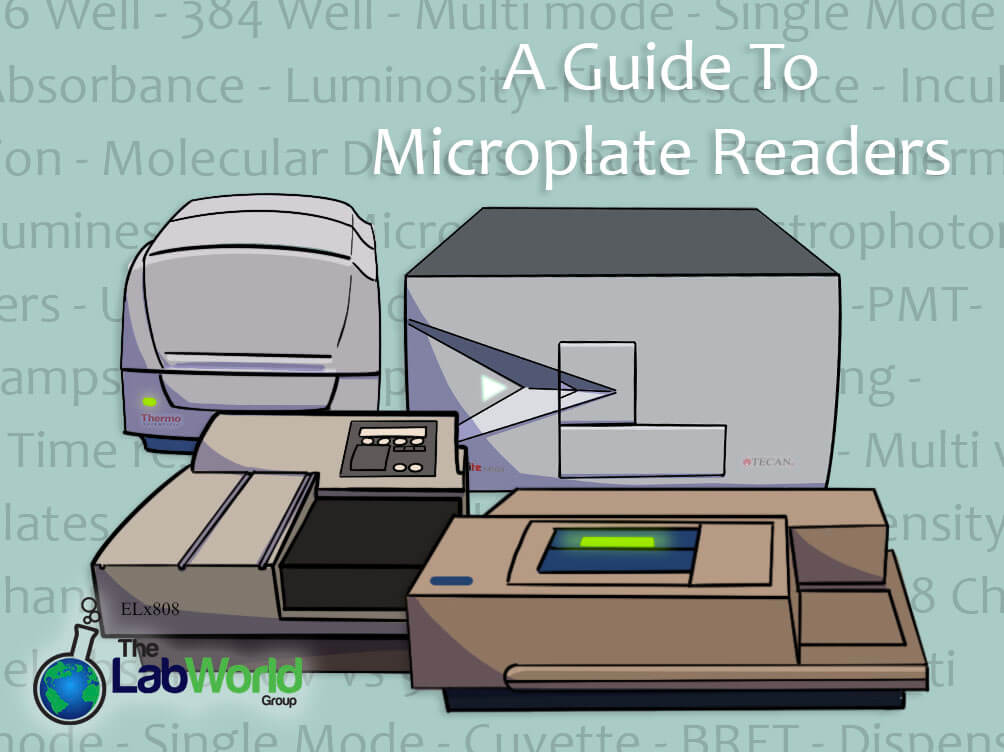
- Tecan microplate readers are another steadfast option, building on the wildly popular Infinite Series over the years. The Infinite plate readers are usually upgradeable, so you can count on this instrument sticking with you through your research.
- Thermo offers a broad range of dedicated multiskan microplate readers, from the modular, upgradeable Varioskan to a more focused fluorometric microplate reader and the routine, application-friendly Multiskan.
In Conclusion
Whether you need a focused instrument or the flexibility of multiple reading options, a microplate reader can help you cover a lot of ground quickly. These lab workhorses can help get your research off the ground, narrow your experiment focus, and increase productivity.
We offer a wide variety of plate readers from leading manufacturers, and our microplate readers follow a strict quality control protocol both when they’re first received and before they are sent to their new home. Buying a gently used plate reader lets labs get the most out of their dollar, potentially expanding the range of options available to them. As always, The Lab World Group is here to help, if there is a function you need and can’t find, let us know and we’ll work with you to find just the right fit.