
Biosafety Cabinet Vs Other Lab Hoods, What’s The Difference?
Amanda2026-08-27T13:04:53+00:00Lab Hood Types
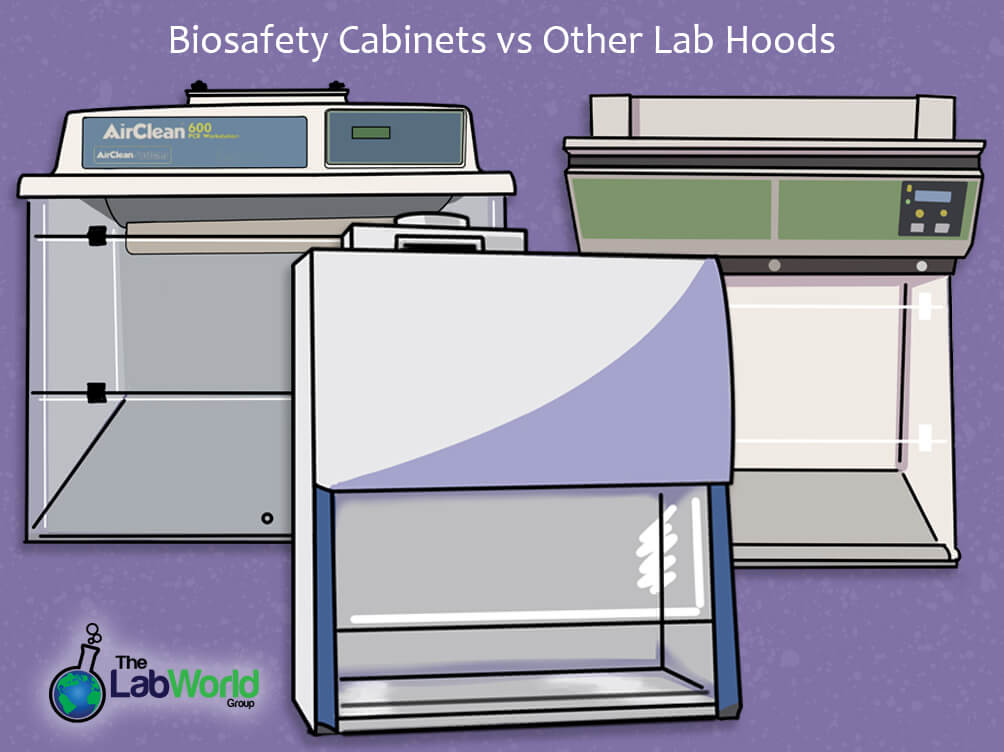
Biological safety cabinets, laminar flow hoods, clean hoods, and culture hoods are often used interchangeably, but their features and end uses make them quite different.
What makes a BSC different than other similarly shaped instruments? The differences boil down to what they’re protecting.
Biosafety Cabinet Classification
To start, a Biosafety Cabinet is built to protect the user, the environment, and the product. These lab hoods require HEPA or ULPA filtration, flow vertically, and exhaust only after decontamination. A BSC comes in three classes depending on the level of biohazard they’re designed for, such as infectious microorganisms and other hazardous particulates. Typically, you find these used in labs focusing on cell culture, life sciences, and microbiology
Chemical Fume Hood
Chemical hoods, on the other hand, are built for, well, chemicals, not biological agents. These lab hoods are still built to protect the users but not the product. HEPA filtration is optional, and air moves away from the user vertically or horizontally; air leaves the building through ductwork. You can usually find a Fume Hood in a laboratory, educational labs, as well as forensics and manufacturing.
Laminar Flow Hood Vs Biosafety Cabinet
A laminar flow hood, or clean bench, doesn’t protect the user; it protects the product from the user. Air comes from the top, pushes down and toward the user, preventing contaminated air from entering the cabinet. These could be used when working with semiconductor wafers, tissue cultures, or other sensitive material. Because air could become contaminated as it flows toward the user, these shouldn’t be used with infectious materials, toxins, volatile chemicals, or materials that may cause hypersensitivity in the worker, such as animal dander.
Biosafety Cabinet Vs Isolator
Aseptic Containment Isolators (CAI), or laminar flow glovebox isolators, provide a complete barrier of protection between the material being worked with and the operator. These hoods are designed for sterile drug compounding and are constructed with a series of HEPA filters and a positive-pressure controlled environment for nonhazardous materials, or negative pressure for hazardous items. The fully enclosed cabinet allows for work with high-level toxic drugs; however, it does not handle heat or smoke very well.
Class III Biosafety Cabinet
A Class III Biosafety cabinet is also gas-tight and features total enclosures and negative pressure; however, these can be ductless or ducted. When set up with ductwork, the BSC can also double as a fume hood to support microbiology processes.
Biosafety Cabinet Vs PCR Hood
A PCR Laboratory hood is like a laminar clean bench, where the filtered air flows down and toward the user. Sometimes these lab hoods are circulation-free, as in the case of a dead air box. However, what sets these apart is the use of UV sterilization you might see in a biosafety cabinet. The germicidal lamp sterilizes between amplifications to prevent cross-contamination between samples, especially for the most sensitive DNA and RNA segment detection.
Final Thoughts
To the uninitiated, the enclosure they see in a lab may recede into the background as just safety equipment. But each type is highly specific, and you should think through the features before buying. When outfitting your lab, consider end use, ductwork access, and the degree of protection needed.
Our team has decades of experience working with lab hoods, biosafety cabinets, glove boxes, PCR hoods, and balance enclosures of all makes and brands. All enclosures that come through our doors are rigorously inspected, decontaminated, and filters checked and replaced. If you have questions, we have answers. Our inventory also changes daily, so if you don’t see something that meets your needs, let us know; we may be able to source it for you.