
A Guide to Bioreactors
Amanda2026-03-06T15:55:38+00:00Microorganisms, plant and animal cells, and tissue need to be grown in industries ranging from pharmaceuticals and vaccine development to fermentation applications and wastewater treatment. These applications call for a bioreactor.
A bioreactor can take several forms, but it is an instrument that controls temperature and gas conditions to create ideal conditions for cell growth. These controlled environments are critical tools in biotechnology. They can be used to develop medicines, foods, tissues, organs, treat waste products, and more. Because their uses vary, many bioreactors have been designed to meet these purposes.
Bioreactor History
Bioreactors operate under a simple theory: heat, pH control, and agitation create a biologically active environment. Bioreactors have been around, going back to the Babylonians. Fermenting Beer and Wine in wineskins became part of the king’s court and, throughout history, was often safer to drink than water. Clay pots were used in Neolithic Turkey to make and store yogurt, preserving dairy. Cultivating yeast allowed the first leavened bread in Egypt.
This early recognition that fermenting, pickling, and curing foods had a dual effect. These bioprocesses enhanced flavors but preserved food in the days before refrigeration. As humans gathered in cities, they learned to treat wastewater in bioreactors to control the spread of disease. They couldn’t have known at the time that microorganisms were the cause, but these cultivation processes became essential to the development of civilization and to extending human life.
These days, Bioreactors have graduated from enzyme- and bacteria-rich animal stomachs, leather, and clay pots to sophisticated instruments with high control over many variables. A bioreactor typically comprises three main components: a container, an agitator, and a means to control environmental factors such as pH, gas levels, and temperature. The goal is to create an ideal, specific environment for growing a microorganism or cell. A bioreactor can be used as a home for cells to transform biochemicals into a product, inactivate cells, degrade pollutants, or even grow plastic-eating bacteria.
What are Bioreactor’s Used For
Bioreactors are employed in both research and industrial environments. They can be used in manufacturing cell and gene therapies, as well as medicinal and research products that require cell growth, enzyme production, and biocatalysis. They can be used in food production for products like milk processing, miso, soy sauce, and wine. Other applications include tissue engineering, algae production, protein synthesis, and anaerobic digestion. They can also be used in opposition to growth to inactivate cells or for sterilization, such as in water treatment.
Types of Bioreactors
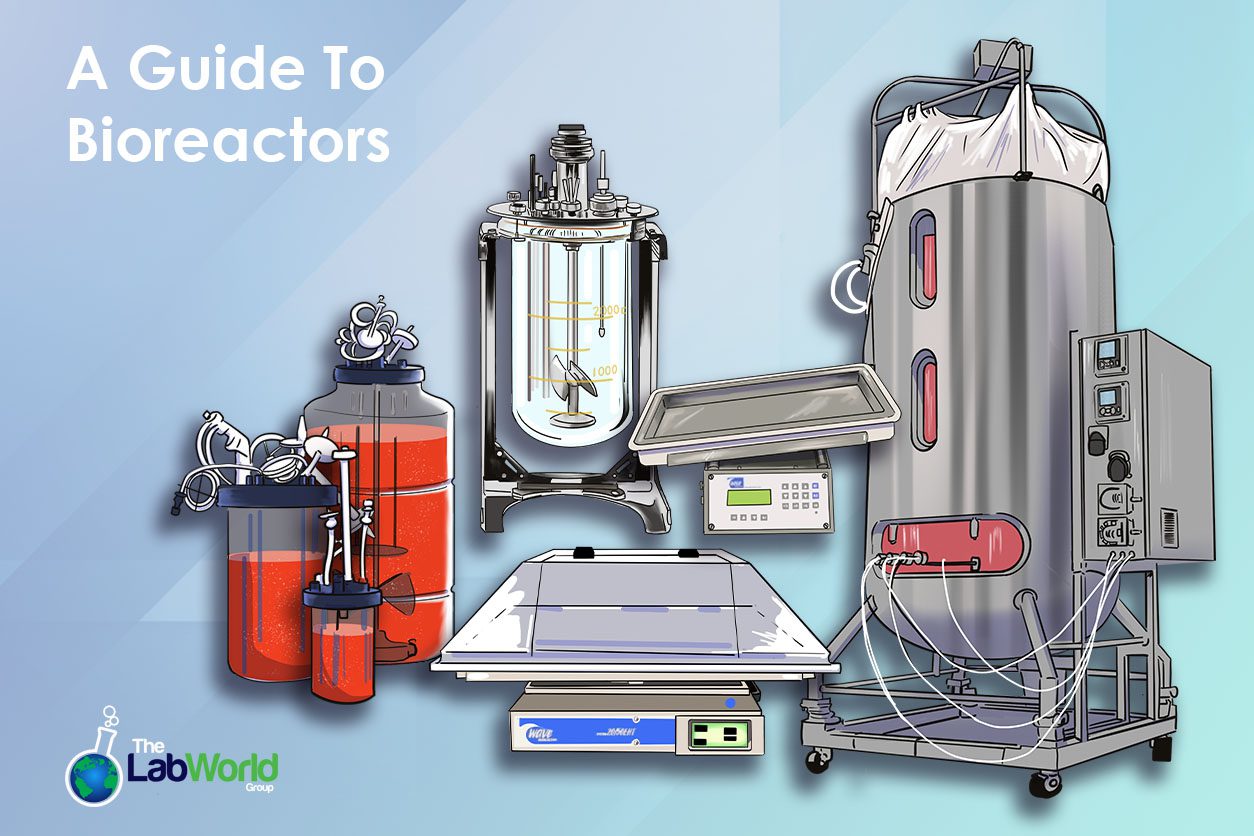
Bioreactors fall into key types: stirred tanks, wave bioreactors, membrane bioreactors, fixed and fluidized beds, and pneumatic or air-pressure agitation. The operations of bioreactors can also be classified as fed-batch, continuous, semicontinuous, and perfusion cultures.
Airlift bubble columns; use a draft tube as an internal or external loop. This type is optimal for wastewater treatment. It’s energy-efficient and simple in design, with no physical agitator required for sterilization. However, they can be expensive to operate as more viscous mediums may require higher air pressure to mix.
The most commonly used continuous stirred tank bioreactor is excellent for pharmaceutical applications. It can run continuously and is easy to clean. Stirred tank bioreactors are also great for large-batch production, as they require little supervision.
A wave bioreactor works with a disposable, single-use bag. The gentle rocking motion introduces oxygen into the culture while controlling other environmental factors, such as heating and monitoring gas levels. These are great options when working with delicate, sensitive cells.
Other bioreactors include fluidized-bed bioreactors, packed beds of solid particles, and innovative photobioreactors that harness photosynthesis and the sun’s power.
Bioreactor manufacturers
Many Bioreactor Manufacturers provide robust features and reliable construction. Here are a few that are at the top of their class.
Cytiva, once known as GE Healthcare, has been a leading manufacturer of Wave bioreactors, single-use systems ideal for product development. They also offer perfusion systems to aid in consistent production.
Beckman Coulter offers a microplate-format bioreactor designed to evaluate aerobes and anaerobes in real time by creating cultivation conditions and allowing users to measure success.
Eppendorf offers bench-scale glass bioreactors that leverage heated blankets, autoclavable glass vessels, and various impellers. Parameters are set through the Bioflow control station, which uses robust software that allows users to scale up to 40L without taking up much space.
Sartorius Bioreactors range from wave bioreactors to large-scale single-use tank bioreactors, covering use cases from research to manufacturing. The innovative multi-parallel bioreactors provide a means of automation process development and cell line selection. These systems can process up to 48 cultivations in parallel, so users can cover more ground in less time.
Other manufacturers include Lonza, Corning, Parr, and Solaris.
Conclusion
Bioreactors have an essential role in the laboratory. Depending on the environment, these carefully controlled conditions can promote or deter the growth of biological materials. Users can control temperature, pH, Oxygen levels, agitation, and perfusion, all in the pursuit of the ideal condition.
We’ve carried many wave and tank bioreactors, as well as peripheral accessories, throughout the years. We can help you find the right instrument with the right level of control and features to help you achieve your goals. Connect with us today for more information.