
All About Microplate Washers
Amanda2026-08-27T15:58:05+00:00Microplate washers are a cornerstone of modern laboratory workflows, particularly in life science, diagnostic, and clinical research environments. A microplate washer is a laboratory instrument that dispenses wash buffer into microplate wells and removes it via controlled aspiration. Washing is a critical step that removes unbound material from the microplate wells. While this process can be done by hand, a plate washer automates it, delivering consistent, reproducible washing, reducing variability, improving assay sensitivity, and increasing laboratory efficiency.
Modern microplate washers support programmable protocols, multiple plate formats, and application-specific washing modes, making them suitable for a wide range of laboratory workflows. This guide provides a comprehensive overview of microplate washers, including how they work, where they are used, how to choose the right system, and how to maintain long-term performance.
The History of Microplate Washers
Microplate washers developed soon after the rise of microplates. In the mid-20th century, as immunoassays and high-throughput screening became more prevalent, laboratories needed a reliable, time-saving way to wash multiple samples simultaneously without manual pipetting. Early plate washing methods relied heavily on handheld squeeze bottles or multichannel pipettes, which introduced variability and increased the risk of contamination.
As ELISA assays gained widespread adoption in the 1970s and 1980s, automated microplate washers emerged to address these challenges. These early systems focused on fundamental aspiration and dispensing functions but laid the groundwork for today’s advanced instruments. Over time, improvements in fluid handling, programmability, and plate compatibility have made modern microplate washers faster, more precise, and easier to integrate into automated workflows.
The Anatomy of a Microplate Washer
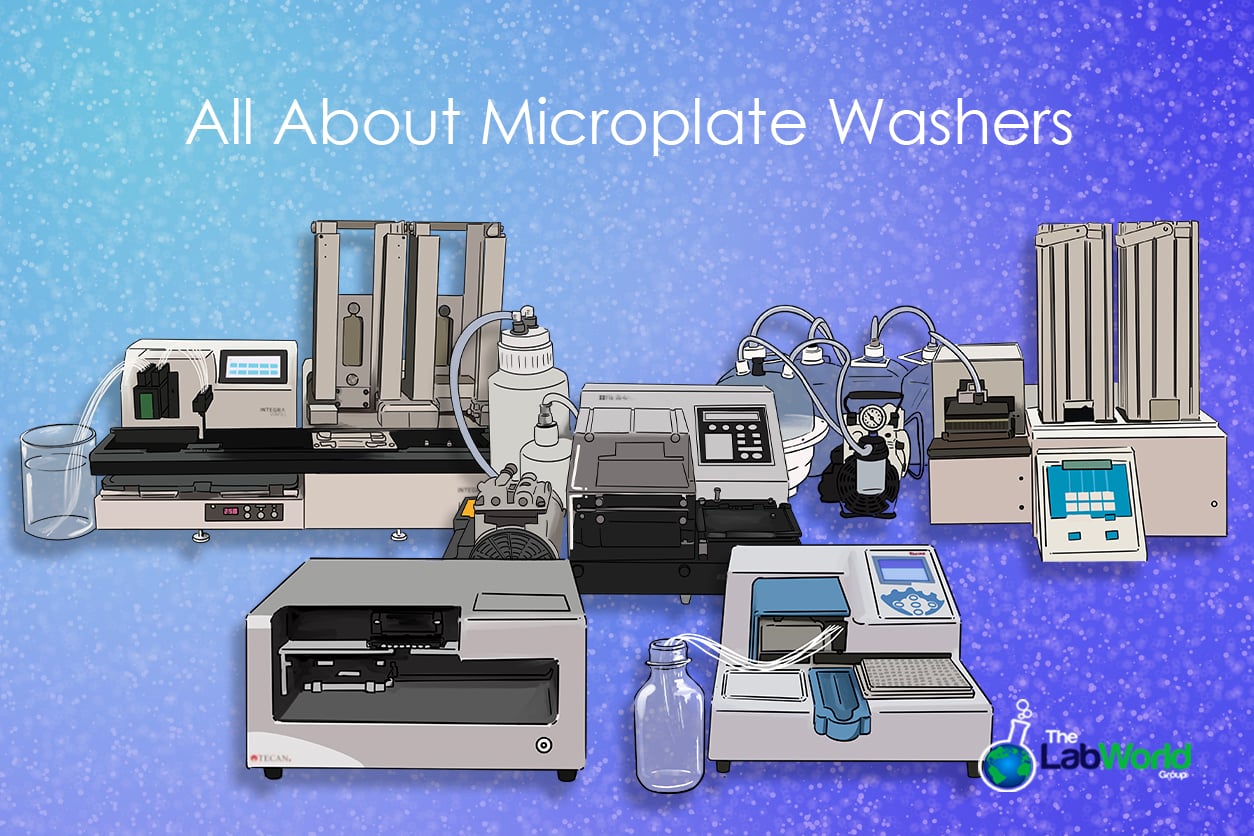
At their core, microplate washers are fluid-handling instruments that dispense wash buffer into microplate wells and remove it efficiently. Most systems consist of a wash head with multiple needles, a vacuum or aspiration system, reagent reservoirs, and onboard controls or software.
The wash head aligns with the plate wells, delivering wash solution evenly before aspirating residual liquid. Advanced systems let users adjust parameters such as dispense volume, aspiration height, soak time, and the number of wash cycles. Many washers also include features like plate shaking, overflow washing, and cross-contamination prevention, all of which help optimize assay performance.
Types of Microplate Washers
Microplate washers come in several configurations, each designed to support different throughput levels and applications.
Manual and Semi-Automated Plate Washers are typically used in smaller labs or low-throughput environments. These systems offer basic programmability and are ideal for routine ELISA workflows where flexibility and cost control are priorities.
Automated Microplate Washers provide higher throughput and more advanced control over wash parameters. These instruments are commonly used in research and clinical labs that handle large sample volumes or run standardized assays.
Strip Washers are designed to wash individual rows or strips of wells rather than entire plates. This makes them especially useful for partial plates or when conserving reagents.
Combination Plate Washers and Dispensers integrate washing and dispensing functions into a single instrument, reducing bench space requirements and streamlining workflows.
Compatibility is another key consideration, as washers may support 96-well plates, 384-well plates, or both, depending on the model.
Manufacturers of Microplate Washers
Several well-established manufacturers produce microplate washers used across research, clinical, and industrial laboratories.
BioTek (now part of Agilent) is one of the most recognized names in microplate washing and detection. Their washers are widely used for ELISA, cell-based assays, and automated workflows.
Thermo Fisher Scientific offers a range of microplate washers designed for reliability and ease of use, often paired with their broader portfolio of assay and automation solutions.
Molecular Devices provides microplate washers that integrate well with high-throughput screening systems and laboratory automation platforms.
Tecan is known for its precision liquid handling systems, including microplate washers that support advanced assay development and automation.
Other manufacturers, such as Awareness Technology, Bio-Rad, and Dynex, also offer dependable plate washers suited for clinical diagnostics, research labs, and teaching environments. With a wide range of configurations available, there is a microplate washer to fit nearly every application and budget.
How to Choose the Right Microplate Washer
Understanding application requirements is critical to selecting appropriate equipment and settings. Choosing the right microplate washer involves evaluating assay types, throughput needs, plate compatibility, wash performance features, and ease of use. Laboratories should also consider maintenance requirements, service support, and long-term scalability.
Both new and refurbished microplate washers can be suitable options when properly evaluated.
Conclusion
Microplate washers have evolved from simple aspiration tools into sophisticated, programmable instruments that support reproducible, high-throughput laboratory workflows. By automating one of the most critical steps in assay preparation, they help reduce variability, improve consistency, and free up valuable lab time.
Over the years, we have worked with a wide range of name-brand microplate washers, from basic ELISA washers to advanced automated systems. Our experience allows us to evaluate, service, and support these instruments so they are ready for reliable use in real-world lab environments. If you’re exploring options or don’t see the exact model you need, contact us. We’re always happy to help you identify the right washer for your application.