
Microplate Reader Manufacturers
Amanda2026-01-16T15:45:51+00:00Last, in our Microplate Reader Series, we’re going to cover Plate Reader Manufacturers and some of the innovations each company can bring. Most major manufacturers offer multiple levels of plate readers, varying in functionality, modularity, add-ons to enhance results, and robust software to help interpret the results they’ve collected.
The major brands on the market have been manufacturing microplate readers and innovating on them for decades. For about thirty years since the instrument was widely adopted by the scientific community, this workhorse has only grown in capabilities and features. The first Microplate reader was created in 1951 by a Hungarian scientist named Dr. Gyula Takatsy; however, it wasn’t until 1980 that the instrument became more mainstream. As of 1990, more than 15 companies worldwide were producing plate spectrophotometers.
Molecular Devices Plate Readers
Molecular Devices microplate reader offerings cover the full range of needs. Their models run from dedicated single-mode microplate readers for Absorbance, Luminescence, or Fluorescence. Within the absorbance models alone, there are multiple tiers increasing in options for sample capacity, cuvette reading, wavelength ranges, scanning speed, and shaking.
Additionally, Molecular Devices has a full line of Multimode microplate readers, continuing the format of each model offering more than the last. The popular Spectramx M series begins with the M2, a reader that covers Absorbance, Fluorescence top and bottom, and goes all the way to the M5E, offering users Absorbance, Fluorescence (top/bottom read), Luminescence (top/bottom read), Time-Resolved Fluorescence top/bottom read), Fluorescence Polarization (top read) and as a bonus, HTRF (top/bottom read). These monochromator systems are dependable and robust, some MD Plate Readers even offer imaging in addition to traditional scans.
Biotek Plate Readers
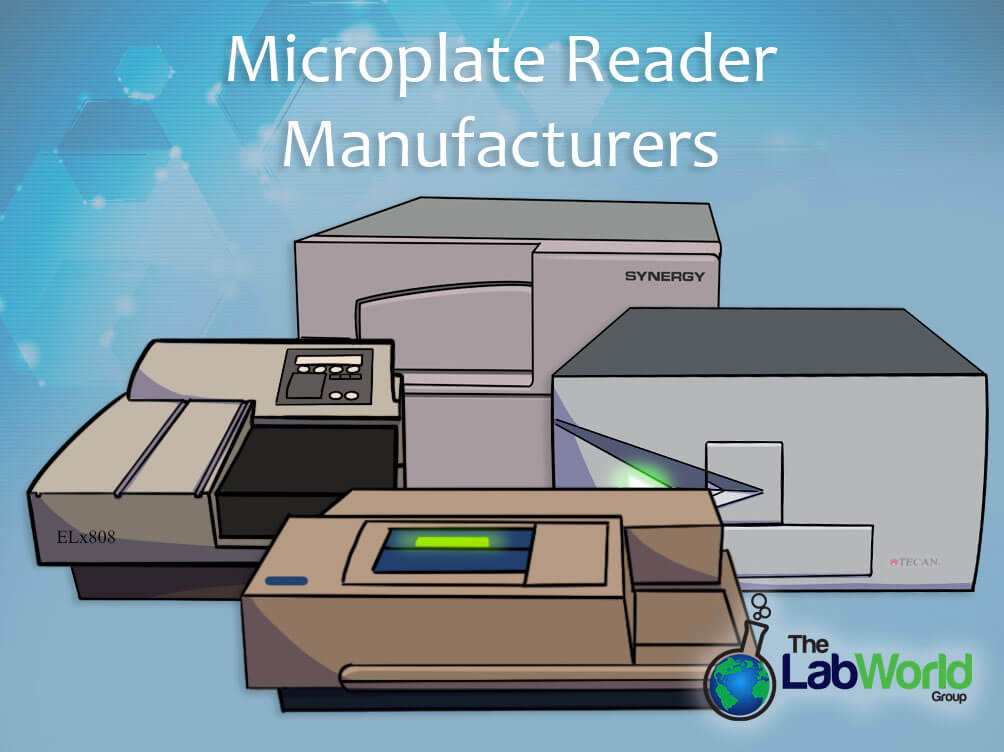
Biotek plate readers have evolved over the years, continually innovating on each model as the line grows. Like Molecular Devices, these plate readers can range from dedicated absorbance readers like the 800 TS Absorbance Reader with filter-based optics to the Synergy HTX Multimode Reader. Well-known models include the Synergy Neo2, the Epoch 2 microplate spectrophotometer, and the ELx808.
Microplate readers from Biotek are often modular, which can be a great way to expand your reach as your project progresses. Some models, such as the Synergy H1, offer hybrid solutions combining monochromators and filter-based optics, allowing users to be flexible in terms of speed and sensitivity. Biotek also offers models compatible with the Take3 plate system for 2 ul low-volume quantifications. Biotek Readers can include dispensing modules that enable strategic addition of reagents during a run. Biotek also offers microplate washers for complete ELISA solutions.
Tecan Plate Readers
Tecan microplate readers, much like Biotek, are another steadfast, often modular option. The Infinite series of plate readers are usually upgradeable so you can count on this instrument sticking with you through your research.
Their line of single-mode readers and multi-mode readers can cover absorbance and luminescence, FI, FP, TRF, FRET, and TR-FRET applications, as well as multiple plate capacities and cuvette options. These instruments use either dedicated or tunable filter-based optics or the innovative quad 4 monochromator technology.
Quad 4, Tecan’s unique system, was introduced with the Sapphire series in 2000. This double-beam technology covers both excitation and emission and employs a subtractive monochromator design. The Subtractive design cancels out the first monochromator’s dispersion, behaving like a tunable filter, and is very good at suppressing stray light without transmission loss.
Thermo Scientific Microplate Readers
Plate readers available from Thermo Scientific run from single-mode to multimode models. The line begins with a fast and economical, routine application-friendly filter-based absorbance reader, Multiskan FC, Luminoskan luminometric microplate reader, and a focused fluorometric microplate reader, Fluoroskan. These singularly focused instruments use swappable filters to customize to specific assay needs and can be a great place to begin. From there, the line reaches the modular and upgradeable Varioskan, expanding not only up to 5 read modes but also plate types as high as 1536 wells. A nice feature of these Thermo Scientific plate readers is their robot compatibility, no matter the level, allowing labs to automate their processes and streamline their workflow.
Final Thoughts….
There are many other top-tier companies beyond the ones mentioned above. These microplate reader manufacturers can include Thermo Scientific, BMG, VWR, Perkin Elmer, Promega, and more. Each of the steadfast brands we’ve mentioned today has a lot to offer and has proven track records of dependability, innovation, and variety. With so many to choose from, it can be daunting, but keeping your needs in mind, what assays you need to perform, and the wavelength range you need to cover, you can narrow the field down.
Another thing to keep in mind is cost. For each additional feature you add, your cost is likely to go up. So how can you maximize your dollar while also future-proofing your equipment? Buying a gently used microplate reader from a reputable dealer is a great way to stretch your budget and get the bells and whistles you want. Our selection of used plate readers is sourced from quality manufacturers and undergo rigorous performance testing, with documentation provided to the buyer so they can feel confident in their purchase.